
Pearl Harbor accessibility is better than most first-time visitors expect: the Pearl Harbor Visitor Center, the Navy boats, and the USS Arizona Memorial are all wheelchair accessible, and most of the site is flat, paved, and step-free.
Pearl Harbor National Memorial is the World War II memorial and museum complex in Honolulu, Hawaii, built around the sunken battleship USS Arizona, where 1,177 sailors and Marines were killed on December 7, 1941.
The honest version is shorter than the brochure version. Almost everything at Pearl Harbor works for a wheelchair or mobility scooter, and one famous site does not work at all.
The two things that catch people out are the distances between buildings and the rule that Pearl Harbor does not lend out wheelchairs.
This guide rates every site one by one, covers strollers, hearing and vision support, service animals, and bag rules, and ends with a half-day plan that keeps the walking — or rolling — to a minimum.
By Best Pearl Harbor Tours — your Honolulu guide to visiting Pearl Harbor without the guesswork.
Key Points
- Pearl Harbor accessibility is strong overall: the Visitor Center, exhibit galleries, theater, Navy boats, and USS Arizona Memorial are all wheelchair accessible.
- Bring your own wheelchair or mobility scooter to Pearl Harbor, because the Visitor Center lends wheelchairs only in emergencies.
- The USS Bowfin submarine is the one site at Pearl Harbor that is not wheelchair accessible, while its museum and park are fully accessible.
- Strollers are welcome at the Pearl Harbor Visitor Center and on the grounds, but strollers cannot board the Navy boats or the USS Arizona Memorial.
- Request an ASL interpreter at Pearl Harbor at least 14 days before your visit, after booking your USS Arizona Memorial reservation.
- Accessible parking sits in the front lot at the Pearl Harbor Visitor Center, and the lot costs $7 per day.
Pearl Harbor Accessibility at a Glance
Start here if you only want the verdicts, then read the sections below for the details that apply to your visit.
| Site | Wheelchair access | What to know |
|---|---|---|
| Pearl Harbor Visitor Center | Fully accessible | Galleries, theater, bookstore, restrooms, and information desk are all step-free |
| USS Arizona Memorial | Fully accessible | Navy boats have ramps and wheelchair locks; no restrooms on the memorial |
| Battleship Missouri | Main deck accessible | Ramp aboard, elevator to the surrender deck; below decks are ladders only |
| Pearl Harbor Aviation Museum | Fully accessible | Hangars 37 and 79 have flat, wide floors, accessible restrooms, shop, and restaurant |
| USS Bowfin Submarine | Not accessible | Steep ladders and narrow hatches inside the submarine; the museum and park are fully accessible |
| USS Oklahoma Memorial | Accessible | Outdoor memorial on Ford Island, reached by the Ford Island shuttle |
| Ford Island shuttle | Accessible | Buses have wheelchair lifts or ramps and run about every 15–20 minutes |
Wheelchairs and Mobility Scooters at Pearl Harbor
The single most important Pearl Harbor accessibility fact is also the easiest to miss: the National Park Service does not lend wheelchairs for general use at Pearl Harbor, and wheelchairs are provided only in emergencies.
Bring your own wheelchair, mobility scooter, or rollator, or arrange a rental before you arrive in Honolulu. Rental companies in Honolulu deliver wheelchairs and scooters to Waikiki hotels, so the device can be waiting for you when you land.
Where wheelchairs and scooters can go
Personal wheelchairs and motorized mobility devices are welcome across the Pearl Harbor Visitor Center, on the US Navy vessels, and on the USS Arizona Memorial itself.
The Navy shuttle boats that carry visitors to the memorial are fitted with ramps for boarding and wheelchair locks that hold your chair steady during the short ride across the harbor.
Rollators are permitted at Pearl Harbor, but the National Park Service advises caution with them, because a rollator is not a substitute for a wheelchair on the longer stretches of the site.
Distances and rest stops
Pearl Harbor is mostly flat, with paved paths and no hills, but the distances between facilities can still be challenging for some visitors.
Benches are placed throughout the Visitor Center grounds for resting, and the sensible plan is to treat the site as a series of short stops rather than one long walk.
Arrive near the 7:00 AM opening and take the earliest USS Arizona Memorial program you can book, when the site is cooler, quieter, and less crowded.
Best Pearl Harbor Tours recommends booking the earliest USS Arizona Memorial program of the day if you use a wheelchair or scooter, because the morning boats run on time, the paths are clear, and the heat has not yet built up on the open memorial.
Site by Site: What Is Accessible and What Is Not
Pearl Harbor accessibility is not one verdict but seven, because each memorial and museum was built in a different era and to a different design.
Pearl Harbor Visitor Center
The Pearl Harbor Visitor Center is designed to be fully accessible for visitors with mobility challenges, and every essential facility is wheelchair accessible.
That includes the restrooms, the movie theater, the two exhibit galleries, the bookstore, the information desk, and the drinking fountains, all reached by wide, level pathways.
The Visitor Center is open daily from 7:00 AM to 5:00 PM, and it is closed on Thanksgiving, Christmas, and New Year’s Day.
USS Arizona Memorial
The USS Arizona Memorial is wheelchair accessible, and the National Park Service lists the memorial, the boats, and the theater among its fully accessible facilities.
Your visit starts with a 23-minute documentary film in the theater, followed by the Navy boat ride to the memorial, and the whole program takes about 45 minutes.
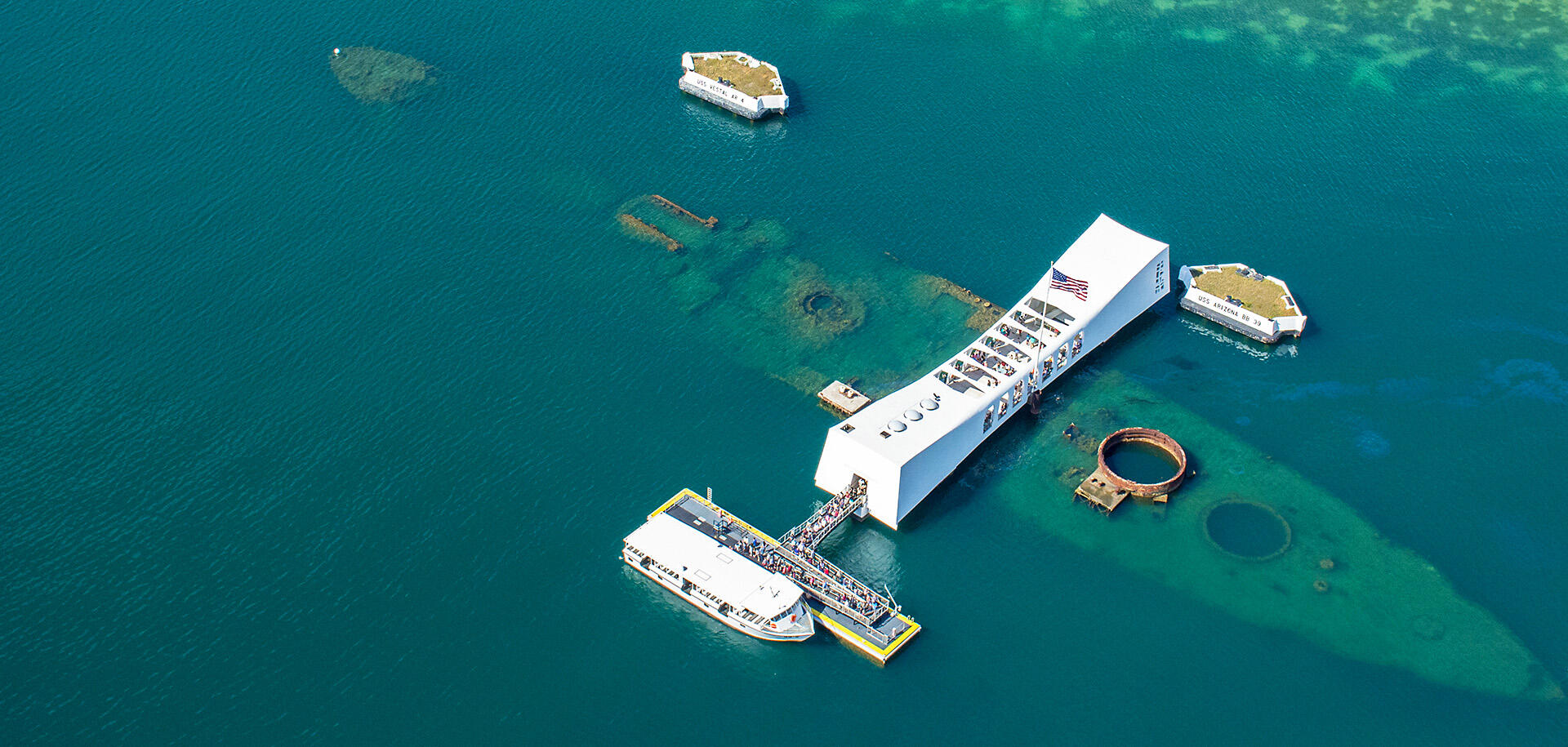
There are no restrooms aboard the USS Arizona Memorial, so use the accessible restrooms at the Visitor Center before boarding the boat.
The memorial program itself is free, and reservations cost a $1 booking fee per ticket through Recreation.gov, with standby places available on the day when boats have space.
Battleship Missouri Memorial
The Battleship Missouri is partly accessible, and the parts that matter most are the parts you can reach.
Visitors using wheelchairs board the Missouri by ramp and can explore the main deck, reach the surrender deck by elevator, and visit Slider’s Grill and the Victory Store.
The interior sections below deck keep their original wartime design, with tight corners and steep ladders, so they are not accessible to wheelchairs or scooters.
Wheelchairs are available to borrow at the Battleship Missouri itself, which makes it the one Pearl Harbor site where you can pick up a chair on arrival.
Pearl Harbor Aviation Museum
The Pearl Harbor Aviation Museum is fully accessible for wheelchair and scooter users, and it is one of the easiest Pearl Harbor sites to enjoy at a slow pace.
All hangars and exhibits, including Hangar 37 and Hangar 79, plus the shop and restaurant, can accommodate wheelchairs, with flat, wide museum floors throughout.
The museum sits on Ford Island, so reach it on the wheelchair-accessible Ford Island shuttle from the Visitor Center, which runs about every 15–20 minutes.
USS Bowfin Submarine Museum and Park
The USS Bowfin is the honest exception in this guide: the submarine itself is not wheelchair accessible, and visitors with limited mobility will have difficulty maneuvering inside it.
The submarine keeps its original layout as a working boat, with steep ladders and narrow hatches, and there is no way to make that step-free without changing the vessel.
The Pacific Fleet Submarine Museum next to the submarine, and the park around it, are both completely accessible, so the Bowfin stop still works as a museum visit even if nobody in your party boards the boat.
USS Oklahoma Memorial and USS Utah Memorial
The USS Oklahoma Memorial is an open-air memorial on Ford Island, next to the entrance to the Battleship Missouri, and it is reached on the same Ford Island shuttle.
Its 429 white marble standards, one for each sailor lost on the Oklahoma, stand on level ground that wheelchairs and scooters can move across.
The USS Utah Memorial sits in a restricted Navy housing area on Ford Island and is not on the regular shuttle route, so it needs a separate reserved NPS shuttle.
That shuttle runs on Monday, Wednesday, and Friday afternoons and is booked through Recreation.gov, so check the current days and times there before planning around it.
Strollers at Pearl Harbor
Strollers are welcome at the Pearl Harbor Visitor Center and on the grounds, but the stroller rules change the moment you head for the boats.
Strollers are not permitted on the US Navy vessels to the USS Arizona Memorial, on the memorial itself, or inside the theater, and a designated area is available to park strollers before the film.
Bring a baby carrier for the boat and memorial stretch instead, and treat the stroller as a Visitor Center and grounds device for the rest of the day.
Fixed pouches on strollers and wheelchairs that cannot be removed are allowed to stay attached, although security may inspect or tag them at screening.
Hearing and Vision Support at Pearl Harbor
Pearl Harbor accessibility covers hearing and vision as well as mobility, and the support is practical rather than decorative.
Hearing support
The documentary film shown before the USS Arizona Memorial program is fully captioned in English, and an induction loop system is available in the theater for visitors using hearing aids.
American Sign Language interpreters can be arranged for the boat ride, the memorial visit, and time with park staff, but they must be requested at least 14 days before your visit.
Book your USS Arizona Memorial reservation on Recreation.gov first, then email the park with the subject line “ASL Interpretive Services Request”, because interpreters are not available without a prior request.
On the Battleship Missouri, a written transcript of the AcoustiGuide audio tour is available at no charge for visitors with hearing impairments.
Vision support
The Pearl Harbor Visitor Center provides braille signage and tactile models of interpretive resources throughout the site, so the story is not only told on flat printed panels.
The National Park Service also offers a braille-ready file of the park brochure, a digital version in braille that vision-impaired visitors can download and print before their visit.
Service Animals and Bag Rules at Pearl Harbor
Service animals are welcome at Pearl Harbor National Memorial, including in the Visitor Center, on the tours, and on the Navy boats to the USS Arizona Memorial.
Pets are not allowed inside the Visitor Center or the memorials, so the distinction is a working service animal, not a companion animal.
The bag rules matter more for accessibility visitors than for anyone else, because medical supplies and device pouches are the items that get questioned at screening.
Bags larger than 1.25 inches by 2.25 inches by 5.5 inches are not allowed at Pearl Harbor, and anything bigger must go into paid storage near the Visitor Center entrance.
Medical bags are an exception to the size rule, and fixed pouches on wheelchairs and strollers that cannot be removed may stay attached, although security may inspect or tag them.
Getting to Pearl Harbor With a Mobility Device
Getting there is half the accessibility question, and Pearl Harbor is well served by accessible transport from Waikiki and Honolulu.
Driving and parking
Reserved accessible parking is available in the front lot at the Pearl Harbor Visitor Center, close to the entrance and to security screening.
Parking costs $7 per day, paid by QR code or on-site kiosk after you park, and the lot fills by mid-morning on busy days, so an early arrival protects both your space and your energy.
TheBus and rideshare
Honolulu’s public bus system, TheBus, is equipped with ramps and can carry two mobility devices per bus, and Routes 20 and 42 run from Waikiki to Pearl Harbor.
Rideshare drop-off at the Visitor Center works for folding wheelchairs and scooters, but confirm the vehicle size with your driver before booking if your device does not fold.
Guided tours and the Ford Island shuttle
The free Ford Island shuttle between the Visitor Center and the Battleship Missouri and Pearl Harbor Aviation Museum is equipped with wheelchair lifts or ramps, and strollers can be stored in the vehicle’s luggage compartment.
Tell the shuttle driver about your needs when boarding, and sit near the front if walking is difficult, so you are first off at each stop.
Guided Pearl Harbor tours from Waikiki vary in accessibility, and not every tour vehicle can take a wheelchair or scooter, so call the operator right after booking to confirm your device fits.
An Accessible Half-Day Plan for Pearl Harbor
A good accessible visit to Pearl Harbor is a short one with the order fixed in advance, not a long day of improvising between buildings.
Arrive at 7:00 AM, use the accessible restrooms at the Visitor Center, and take the earliest USS Arizona Memorial program you booked, while the boats and paths are quiet.
After the memorial, tour the two Visitor Center galleries at your own pace, then rest over a drink before deciding whether Ford Island is worth the shuttle ride.
If you go to Ford Island, visit the Battleship Missouri main deck and the Pearl Harbor Aviation Museum, and skip boarding the USS Bowfin submarine in favor of its fully accessible museum and park.
Plan on three to four hours for the accessible essentials, and treat the Missouri and Aviation Museum as a second half-day if energy runs low rather than pushing through them tired.
Location Map
Pearl Harbor National Memorial sits at 1 Arizona Memorial Place, Honolulu, HI 96818, about a 30-minute drive from Waikiki without traffic.
Open Pearl Harbor National Memorial in Google Maps
Pearl Harbor Accessibility FAQs
Is Pearl Harbor wheelchair accessible?
Yes, Pearl Harbor is largely wheelchair accessible: the Pearl Harbor Visitor Center, the Navy boats, and the USS Arizona Memorial are all wheelchair accessible, as are the Battleship Missouri main deck and the Pearl Harbor Aviation Museum.
The one exception at Pearl Harbor is the USS Bowfin submarine, which is not wheelchair accessible, although its museum and park are fully accessible.
Can you take a wheelchair on the boat to the USS Arizona Memorial?
Yes, you can take a wheelchair on the boat to the USS Arizona Memorial, because the US Navy shuttle boats are fitted with ramps for boarding and wheelchair locks that hold the chair steady during the ride.
The USS Arizona Memorial itself is fully wheelchair accessible once you step off the boat.
Does Pearl Harbor rent wheelchairs?
No, Pearl Harbor does not rent wheelchairs for general use, and the Pearl Harbor Visitor Center provides wheelchairs only in emergencies.
Bring your own wheelchair or mobility scooter to Pearl Harbor, or arrange a rental in Honolulu before you arrive, because the Battleship Missouri is the only site that lends wheelchairs on arrival.
Can you bring a mobility scooter to Pearl Harbor?
Yes, you can bring a mobility scooter to Pearl Harbor, and personal wheelchairs and motorized mobility devices are welcome at the Pearl Harbor Visitor Center, on the Navy vessels, and on the USS Arizona Memorial.
Arrange the scooter rental before your trip, because Pearl Harbor has no rental desk on site and Honolulu rental companies deliver scooters to Waikiki hotels.
Are strollers allowed at Pearl Harbor?
Yes, strollers are allowed at the Pearl Harbor Visitor Center and on the grounds, but strollers are not allowed on the Navy boats, on the USS Arizona Memorial, or inside the theater.
Park the stroller in the designated area before the documentary film at Pearl Harbor, and bring a baby carrier for the boat and memorial visit.
Is the Battleship Missouri wheelchair accessible?
The Battleship Missouri is partly wheelchair accessible: the main deck is reached by ramp, the surrender deck is reached by elevator, and wheelchairs are available to borrow at the Missouri.
The below-deck areas of the Battleship Missouri are not accessible, because they keep their original design with steep ladders and tight corners.
Conclusion
Pearl Harbor accessibility is genuinely good, with one honest exception: the Visitor Center, the Arizona Memorial, the Missouri main deck, and the Aviation Museum all work for wheelchairs and scooters, while the Bowfin submarine does not.
The visit goes smoothly when you bring your own device, book the earliest Arizona program, and treat the distances between buildings as the real challenge rather than the buildings themselves.
Plan the rest of your visit with our USS Arizona Memorial tickets guide for the Recreation.gov reservation walkthrough and the Pearl Harbor Visitor Center first-visit guide for the free museums and bag rules.
Read how long to spend at Pearl Harbor to size your day, and the best time to visit Pearl Harbor to pick your morning.
For the sites themselves, read the USS Missouri Battleship Memorial guide, the Pearl Harbor Aviation Museum guide, and the USS Bowfin Submarine Museum guide.
Finally, check the Pearl Harbor Passport before deciding which tickets to buy.
Best Pearl Harbor Tours — Pearl Harbor is open to everyone, and the best visits are the ones planned around what each site can actually offer.